

This week and next, exam results are landing up and down the country. If yours came out the way you hoped, congratulations, that’s wonderful news. And if they didn’t, we want you to hear this clearly: it really isn’t the end of the world. It’s just a bump in the road, even if it feels like the ick of the century right now.
What matters most is how you respond once the result is in front of you. The next hour, the next day, the next week- that is where the real work happens. Anyone who has been through the exam system knows what it feels like to open an envelope or a screen and feel knocked back by what’s inside.
Here are a few gentle, simple things you can try when that happens to you.
Feel it before you try to fix it
When a disappointing result lands, the instinct is usually to leap straight into fixing it, or to push it away and pretend it doesn’t matter. Neither really works. Feelings that get pushed down tend to come back later, showing up as worry, snappishness, or a sudden loss of motivation you can’t quite explain. A kinder first step is to give yourself a few minutes to just sit with what you are feeling.
Say it out loud, to yourself or to someone you trust: “I am really disappointed about this.”
Naming a feeling like this, plainly and out loud, tends to take some of the sting out of it almost straight away. You are not wallowing. You are letting the feeling move through you instead of getting stuck. This isn’t main character breakdown behaviour; it’s just what being a normal human feels like sometimes.
Yosi Amram talks about a powerful way to notice your emotions, and if you want, scroll down to jump right into it. If you require visual support, you can check our blog “Restorative Practices for SEN: A Practical Guide for Parents and Educators” and check out the zone of regulation to understand your feelings.
Notice the story you are telling yourself
Once the first sting has passed, pay attention to what your mind does next. This is often where the real damage happens, more than the result itself. One low mark can quietly turn into something much bigger in your head: “I am just not good enough,” or “I have ruined everything.”
Try writing down the very first thought that pops up, word for word. Then, next to it, write down the actual evidence for it and against it.
More often than not, the evidence for the worst version of the story turns out to be thin, while the evidence for something gentler, “that topic just tripped me up”, holds up a lot better. Rewriting the thought this way, more fairly and more accurately, is one of the best ways to stop a poor result turning into a poor story about who you are.
Here is a guide from the NHS that might be helpful in reframing your thoughts.
Look at what actually happened
Rather than avoiding the result once the dust has settled, take a breath and look closely at what went wrong. Sit down with the paper or the feedback in front of you and sort the issues into simple groups: something you didn’t know, a question you misread, running out of time, or trouble focusing that day.
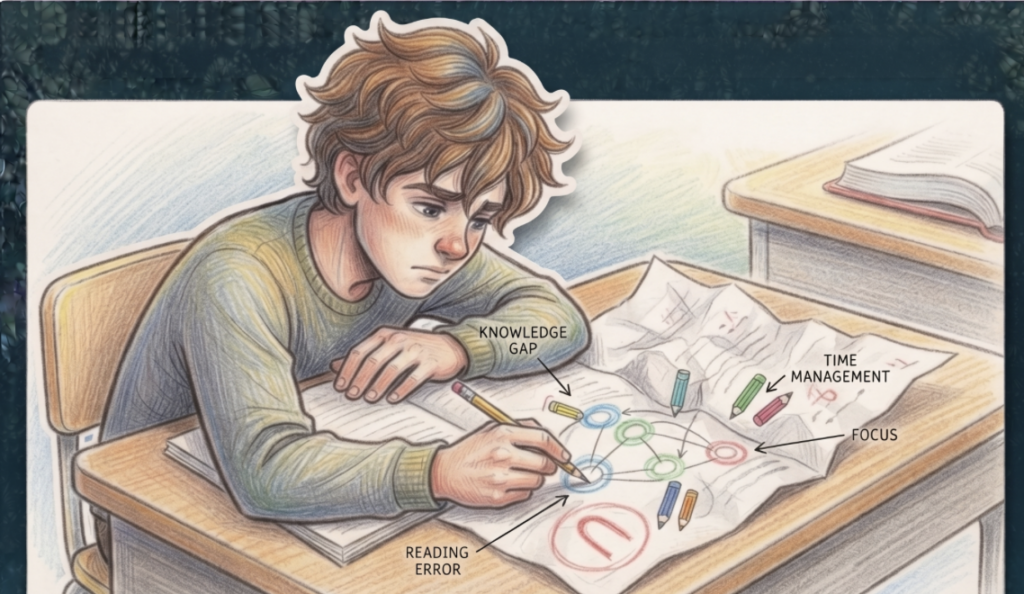
This turns a vague, heavy feeling of “I did badly” into a short, ordinary list of things to work on. Most disappointing results are not caused by one huge mistake. They are usually a handful of small, fixable slip-ups. Once they are laid out plainly, they tend to feel a lot less overwhelming than the dread did.
Take one small step
Once you can see where things went wrong, resist the urge to fix everything at once with some big new plan. Confidence is built from small wins, not grand gestures.
Pick something you can finish in about twenty minutes, less time than it takes to argue with your mates about what to watch. Redo a few questions from the topic that tripped you up. Rework one paragraph using the feedback you were given. Do it, and take a moment to notice that you did.
That small bit of proof, that you can move forward, is exactly what you need after a setback. String a few of these together over the next few days, and the disappointing result starts to feel like a normal part of learning, not a verdict on who you are.
Focus on what you can control
The result itself is already done, and there is nothing you can do to change it now. Replaying it, comparing it to what others got, or imagining the worst will only make things harder. What you can control is what comes next: the next study session, the next conversation with a teacher, the next small step forward.

Keep your attention there, rather than getting pulled back into a result that is already behind you.
Say it out loud to someone
Keeping a disappointing result to yourself tends to make it feel heavier than it really is. Talking it through with a teacher, a parent, or a friend, even briefly, can give you a bit of perspective on something your own mind has probably been blowing out of proportion. It doesn’t need to be a long conversation.
Simply saying what happened, what you found hard, and what you are planning to try next can turn a result that feels like a dead end into useful information you are already acting on.
Why Koji Kojo makes this normal practice
None of this asks you to pretend a poor result doesn’t matter, or that you should just will yourself to feel better about it. These small steps work because they give you something real to do with the disappointment, rather than leaving you to sit with it alone.
That’s why Koji Kojo builds in frequent, small progress check-ins, rather than waiting for one big test at the end of the term to tell the whole story. Catching a dip while it is still small, working through it gently, and noticing the small steps that follow means a tough result gets felt, worked through, and then left behind. It is never carried forward as proof that you are not good enough, or that your brain is not built the right way.
One paper doesn’t get to live rent-free in your head forever.

Suggestions
If you want to learn more about ways to deal with the anxiety that follows results, you can check our post on Instagram here.